
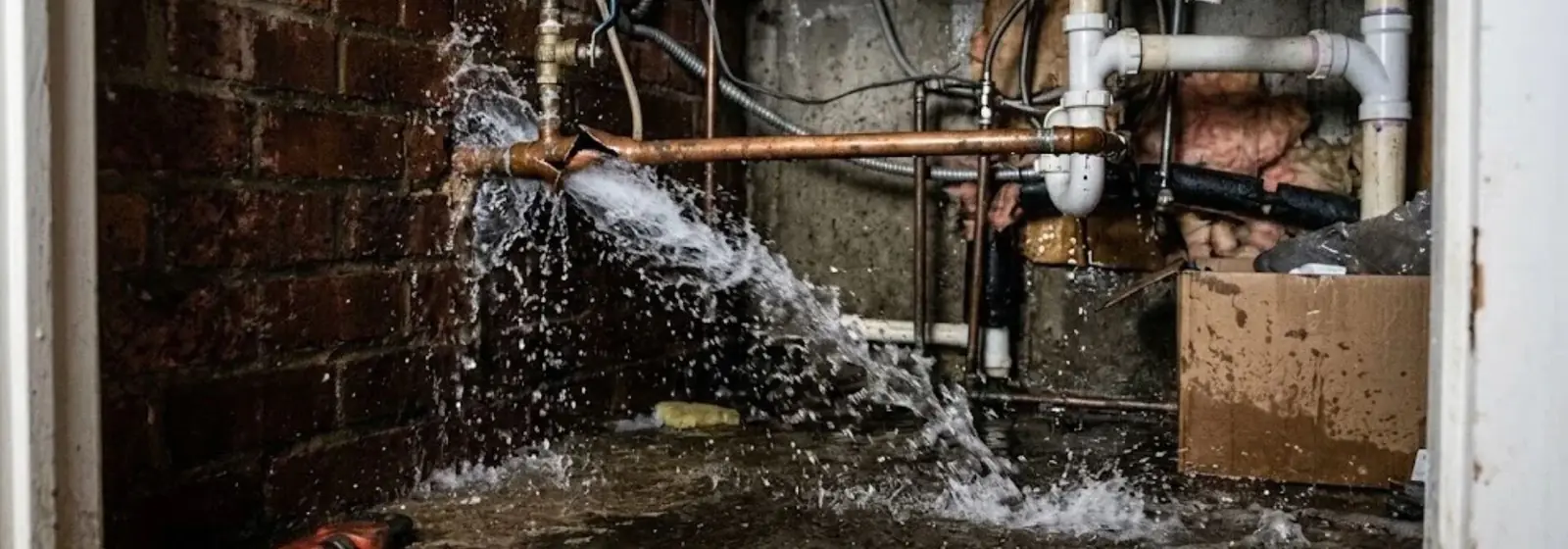
Emergency Burst Pipe Repair in Suisun City, CA
Water spraying from a wall, ceiling or crawlspace is a minutes-matter problem, and our line is open 24/7. Shut the main valve now, then call while the water is stopped.
Stop the Water: The First Ten Minutes
Where you shut off the water matters more than anything else you do before a plumber arrives.
Find the main shutoff
It is usually a valve near the front of the house, by the water heater or in a garage wall. A quarter-turn lever or a round wheel are the two common types.
Close it all the way
Turn a wheel clockwise or swing a lever across the pipe. Open a low faucet afterward to drain what is left in the system.
Kill power near the water
If water is dripping near outlets, light fixtures or a panel, turn off those circuits at the breaker only if you can reach it while dry.
Contain and call
Put buckets, towels and a wet vac to work. Then call the 24/7 line and tell the dispatcher where the water is coming from.
Pipe Burst? Do This Before We Arrive
These steps limit damage to floors and belongings in the time before a plumber reaches you.
Empty the lines
With the main closed, open the lowest tap in the house and flush toilets once. Less water in the pipe means less to spill.
Shut off the water heater
Switch off power to an electric unit or set gas to pilot. A tank feeding a broken line can keep pushing hot water out.
Move the valuables
Pull electronics, paper and rugs from the wet area first. Furniture legs can be propped on foil or plastic to protect finishes.
Document the damage
Take photos and short videos of the break and wet surfaces before cleanup. Your insurer will likely ask for them.
Know when to leave
If water is pouring through a light fixture or the ceiling is sagging heavily, stay out of that room and tell the dispatcher.
A controlled hole at the lowest point of a bulging ceiling lets water drain into a bucket instead of coming down all at once.
Call the 24/7 line nowWhy Pipes Burst in a Mild Climate Like Suisun City
Freezing is uncommon in a warm-summer Mediterranean climate, so most bursts here trace to something else.
Corroded or worn pipe
Old galvanized, thin copper or tired fittings can fail without warning, usually at a joint or an already weak patch.
High water pressure
Pressure that runs above normal stresses every fitting in the house. A failing pressure regulator can set up a burst in a weak spot.
Scale and hard water
At 170 ppm, local tap water leaves mineral buildup that can narrow pipes and crust joints, which adds to wear over time.
Ground and structure movement
Buried lines in soft marsh soil can be stressed by shifting ground. Sags in a crawlspace or under a slab can pull on a pipe until it splits.
Water stopped but the pipe is still broken?
Call the 24/7 line. A shutoff is a pause, and the broken section still has to be repaired.
A Temporary Patch Versus a Real Repair
Clamps and tape can buy time. They do not turn a broken pipe into a sound one.
Temporary measures
- Rubber and hose clamp wraps
- Epoxy putty on a pinhole
- Self-fusing tape
- Pipe caps on a dead-end stub
- Shutting a branch valve and leaving it
A proper repair
- Cut out the damaged section
- Join new pipe with a fitting made for that pipe material
- Test pressure before closing the wall
- Replace nearby pipe if it looks worn
- Explain the price before work starts
A patch is fine as a bridge until a plumber arrives. Leaving one in place for months invites a second failure at the same spot.
Common Pipe Materials and How Each Is Repaired
The pipe type in your wall changes the repair method. Technicians identify it on arrival.
| Pipe type | Typical weak point | Common repair |
|---|---|---|
| Copper | Pinholes, corroded joints | Cut out the bad section and sweat or press in a new piece |
| PEX | Fitting connections, sun-damaged runs | Replace the fitting or the damaged length with crimp or expansion joints |
| CPVC | Brittle sections, glued joints | Cut and replace with new CPVC and fresh solvent cement |
| Galvanized steel | Rust from the inside, threaded joints | Replace the section, often moving toward a larger repiping plan |
Drying Out After the Water Is Gone
Stopping the spray and fixing the pipe is only half the job. Wet drywall, insulation and carpet padding keep holding moisture, and mold can start within a couple of days.
Open the wall or ceiling cavity as needed, run fans and dehumidifiers and let the structure dry before closing it up. The California Plumbing Code, built on the Uniform Plumbing Code (UPC), also expects the repaired line to be pressure tested and to hold before the wall is sealed. Call your insurer early, and ask what documentation they need.
When a Burst Points to a Bigger Problem
A single break in a recently repaired line is bad luck. A second or third break in the same house suggests the whole system is wearing out.
Patterns worth taking seriously
Rust-colored water, low pressure, mineral crust on joints and several leaks in a short time all point to aging supply pipe. Much of the housing here dates from the late 1970s through the 1990s, so older supply lines are worth checking.
What to do about it
A whole-house repiping plan replaces the supply system in one project. If the breaks are hard to place, leak detection can map which sections are failing.
What Shapes the Price of a Burst Pipe Repair
Prices depend on the job in front of the plumber. These are the main drivers.
You get a clear price before work starts. Call the 24/7 line for your real number.
Burst Pipe Help Beyond Suisun City
The same 24/7 line serves homeowners in nearby towns. Callers in Fairfield and Vacaville get the same licensed and insured plumbers.
If the break is on the buried line from the meter, water line repair covers that part of the system.
Burst pipe questions people ask us
Yes. The line is open 24 hours a day, every day. Shut the main valve first, then call so the plumber knows the water is already stopped.
It is commonly near the front hose bib, by the water heater, in a garage wall or in a utility closet. If you cannot find it, the meter box at the curb has a utility valve, and the dispatcher can help you locate it.
Yes, though the causes differ. Age, corrosion, pressure problems and failed fittings do most of the damage in a mild climate, and hard water at 170 ppm adds mineral buildup over time.
Once the plumber has finished and the system is tested, yes. Run the taps briefly to clear air and any loosened debris from the lines.
Many policies cover sudden bursts and not slow leaks, but terms vary. Take photos, keep the damaged section if you can and call your insurer early.
A single break in sound pipe is a repair. Repeated failures, rust-colored water or low pressure make repiping worth considering, and the repiping page explains the process.
Use the License Check tool at cslb.ca.gov or call the California Contractors State License Board. A license number printed on an ad may not be valid, so confirm the status.