
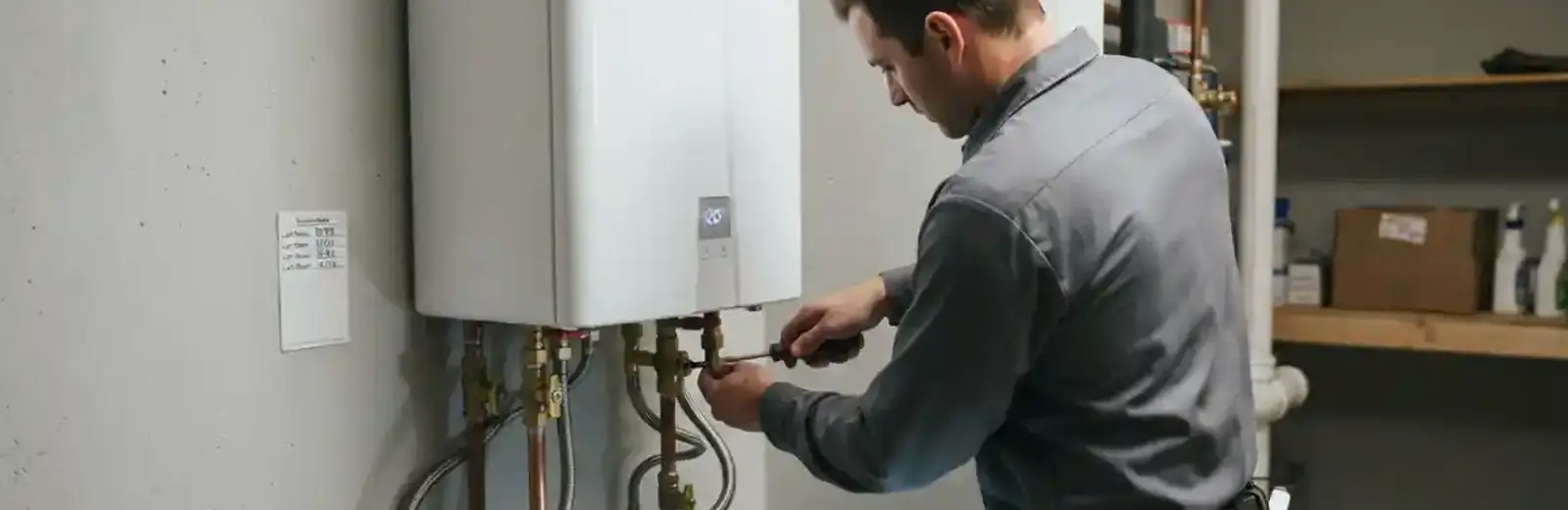
How to Replace a Tankless Water Heater in Suisun City, CA
To replace a tankless water heater, a plumber shuts off gas or power and water, isolates and drains the unit, disconnects the vent and lines, mounts the new heater, and tests everything. A like-for-like swap is simpler than a first install, but gas, venting, and flow settings still need a licensed hand.
Repair, Flush, or Replace? Start With the Symptoms
Not every cold-water complaint means a dead heater. Scale in the heat exchanger, a clogged inlet screen, or a failed sensor can mimic a unit that is finished.
A technician reads the error code, checks flow and gas pressure, and tells you which path makes sense. If the heat exchanger has failed or repairs keep recurring, replacement usually wins.
Warning Signs a Tankless Unit Is Near the End
These clues point toward replacement rather than another repair.
Cold bursts mid-shower
Water runs hot, then cold, then hot again even after a cleaning. The exchanger may be too scaled to hold temperature.
Repeated error codes
The same fault returns after each reset or repair. The display is flagging a part that no longer works reliably.
Leaks at the unit
Water dripping from the cabinet or under the heater often means a cracked exchanger or a failed internal seal.
Rising gas use
The burner runs longer to deliver the same heat. Scale insulates the exchanger and wastes fuel.
What Suisun City's Hardness Does to a Tankless Heater
Water hardness in Suisun City tested at 170 ppm in March 2025, which works out to roughly 9.9 grains per gallon. That sits in the hard band of the common USGS scale, close to the top.
Tankless units heat water through narrow passages, and scale narrows them further. Following the maker's flush schedule matters here, and a water softener or filter upstream protects the new unit from the first day.
Source: City of Suisun City 2025 Water Quality Report, hardness sampled March 18, 2025.
What Happens During a Replacement Visit
A same-fuel swap on a clean wall mount takes the least time. Changes in size, fuel, or vent type add work.
Isolate and drain
Gas or power is shut off, the isolation valves are closed, and the unit is drained so the lines can be disconnected safely.
Remove the old heater
Vent, gas, and water connections come off. The plumber checks the wall mount and the condition of the vent pipe.
Mount and connect
The new unit is fastened to the wall, then gas, water, vent, and condensate lines are hooked up. Isolation valves are added if the old setup lacked them.
Fire up and set flow
The plumber purges air, lights the burner, tests every joint, and confirms the temperature setting and flow rate.
Safety Steps If Your Tankless Unit Acts Up
Handle these in order before anyone touches the unit.
- Smell gas? Leave. Get everyone outside, do not flip switches, and call 911 from outside before you call a plumber.
- Treat venting trouble as a CO risk. A loose, disconnected, or sooty vent can send exhaust into the house. Open windows, leave if anyone feels dizzy or sick, and keep the unit off.
- Watch for scalding water. A faulty sensor can send water far hotter than the setting. Test with your hand before bathing, and keep children away.
- Know what to shut off. Close the gas valve to the unit and the cold water isolation valve. For an electric model, switch off its breaker.
- Do not remove covers. Leave internal parts to a licensed technician. Call the 24/7 line and describe the error code.
Want a straight answer on your tankless unit?
Call the 24/7 line and describe the symptoms.
Choosing the Next Unit Before the Old One Quits
Start with how much hot water you need at the same moment. Two showers and a running dishwasher call for more flow than one shower alone, and tankless ratings are about flow, not tank size.
Next, look at what the old unit taught you. If it struggled when two people showered, size up. If the family shrank, a smaller unit may do the job and save fuel.
Think about the fuel and the vent
A new unit needs the same fuel, or a conversion that your plumber has to plan. Venting is the detail that surprises people, since newer models often use different pipe and routing. Ask your plumber to confirm the vent material and routing match both the maker's instructions and the California Plumbing Code, which is built on the Uniform Plumbing Code (UPC).
Ask about the first-year routine
Request a simple maintenance schedule in writing. A flush on the right interval is the simplest way to protect a unit in hard water and keep its flow steady.
Same Model or a New Size? What Changes
Choosing between a like-for-like swap and a different unit affects the scope of the work.
| Situation | Typical work | What to ask |
|---|---|---|
| Same fuel, same size, same location | Direct swap on the existing connections | Are the vent and shutoffs still in good shape? |
| Larger unit for more demand | Gas line or vent upgrade may be needed | Can the gas supply meet the new load? |
| Switch from tankless to tank | Reconnect to a storage heater with vent and bracing | Is there floor space and a drain nearby? |
| New location | Fresh gas, water, and vent runs | Does the Building Division need to review it? |
Permit rules vary, so ask the Suisun City Building Division at 707-421-7317 whether your job needs one. Check current counter hours.
Homeowner Chores and Pro-Only Steps
A few tasks are easy to do yourself, and others carry real risk.
Reasonable to try yourself
- Cleaning the inlet screen
- Reading the display code and writing it down
- Clearing space around the unit
- Shutting off gas and water in an emergency
Better left to a plumber
- Gas line work and leak testing
- Venting changes and condensate drains
- Flow and temperature calibration
- Diagnosing a failed exchanger
- Anchoring the unit to the wall
Tankless heaters are less forgiving of poor venting or low gas supply than a storage tank. If you are sizing a new unit, our water heater installation team can check gas supply and vent runs on the spot.
Planning Around a Few Days Without Hot Water
A planned swap rarely leaves you without hot water for long, but gas or venting surprises can stretch the job. Schedule it on a day when you are home and the area around the unit is clear. Our tankless water heater technicians can confirm flow and vent needs before the day you schedule.
If the unit fails first, you still have options. Our water heater replacement team handles emergency swaps around the clock, including tank units if that suits your home better.
What Moves the Price of a Tankless Swap
You get a clear price before work starts. These factors decide where it lands.
A tankless unit usually costs more up front than a tank unit but can cost less to run. Call the 24/7 line for your real number.
Tankless Replacement Questions
Lifespan depends on the model, usage, and water quality. Scale from hard water shortens it, so regular flushing and a softener help. Your plumber can tell you how worn your exchanger is.
Yes, and a direct swap is the easiest case. The plumber still checks the vent, gas supply, and shutoffs to make sure the new unit has what it needs.
Often yes. A flush clears scale and may restore normal heat. If the symptoms return soon after, the heat exchanger may be damaged and replacement becomes the better option.
California Health and Safety Code section 19211 applies to standard storage heaters of 120 gallons or less. A tankless unit hangs on the wall, so ask your plumber how it should be anchored.
Call the 24/7 line. Shut off any visible leak at the unit first, and keep gas valves closed if you smell gas. For a gas smell, leave the house and call 911.
Sometimes. A storage tank needs floor space, bracing, and a vent, but it suits homes where gas supply or budget makes tankless harder. Describe your setup on the call and we can compare both.
Note the brand, the error code on the display, and when the trouble started. Mention whether the unit runs on gas or electricity and where it is mounted. Those details let the dispatcher plan the right parts for the visit.