
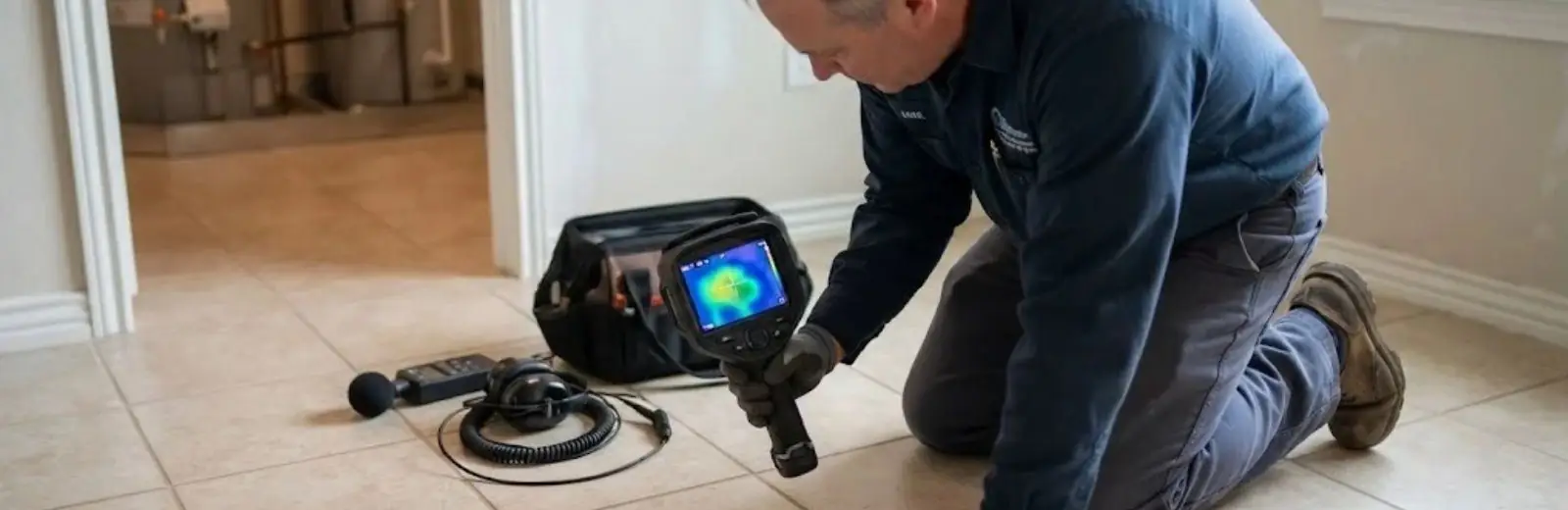
Free Water Leak Detection at Home: Suisun City, CA Guide
To check for a hidden leak yourself, shut off every tap and appliance, read your water meter, wait an hour without using water, and read it again. If the numbers changed or the leak indicator is spinning, water is escaping somewhere. This is a do-it-yourself test, and it tells you whether to keep looking or call a plumber.
The One-Hour Water Meter Test
You need a flashlight, a pen, and an hour when nobody is home using water.
Stop all water use
Turn off faucets, the dishwasher, the washing machine, and the ice maker. Make sure no one flushes a toilet during the test. If you have an irrigation system, pause it.
Find and open the meter box
The meter usually sits in a lidded box near the curb or the front of the property. Lift the lid carefully, since insects and debris collect inside. Wipe the glass clean.
Check the leak indicator
Most meters have a small triangle or star-shaped dial that spins when any water moves through. If it turns with everything off, you have a leak right now. Write down the main reading either way.
Wait, then compare
Leave everything off for an hour and read the meter again. Any change in the number, or a dial that moved, confirms water is leaving the system.
What the Result Tells You
No change at all means the supply pipes are probably holding. A leak that only runs when something is in use, such as a toilet that refills after flushing, can still exist, so keep reading the sections below.
If the dial moved
Now you know the leak is somewhere between the meter and a fixture. The next job is narrowing it down. Do not assume the first wet spot you see is the source, because water travels along pipes and framing before it shows up.
If the meter was still
Run the test again after a night when the household has not used water for several hours, so even a very slow leak has time to register. A tiny drip at a fixture may take longer to show up on the dial than a broken pipe will.
Narrowing Down the Source
Once the meter says there is a leak, work through the likely culprits in this order.
- Toilets first. Drop a few drops of food coloring in the tank and wait 15 minutes without flushing. Color in the bowl means the flapper is leaking.
- Dripping faucets and showerheads. A single drip per second wastes a surprising amount over a day. Look under sinks too, where supply lines and shutoff valves weep.
- Outdoor spigots and irrigation. Check hose bibs, sprinkler valves, and any drip line for wet soil or pooled water near the house.
- Water heater and softener connections. Look at fittings, the base of the tank, and any relief valve discharge pipe for moisture or rust streaks.
- Floors, walls, and ceilings. Warm spots on a floor, bubbling paint, a musty smell, or sounds of running water when everything is off suggest a hidden pipe leak.
Meter spinning and nothing visibly wet?
Call the 24/7 line to have a plumber trace the leak with the right equipment.
DIY Checks Versus Professional Tracing
A meter test is a good first step. Some situations call for more than that.
| Situation | What you can do | When to call a plumber |
|---|---|---|
| Toilet runs after flushing | Dye test, replace flapper | Tank or fill valve still leaks after new parts |
| Meter moves, no visible water | Check fixtures and outdoor lines | No leak found after one pass |
| Warm spot on a floor | Shut off water to the house if it grows | Right away, since this can mean a slab line |
| High bill, no change in habits | Run the meter test | If the test is positive and you cannot find the source |
| Wet drywall or ceiling stain | Stop water use in that area | Always, to avoid mold and further damage |
Why Hidden Leaks Matter
Water moves along the easiest path, so the damp spot is rarely above the break. A leaking joint in a wall can run down studs and show up in a baseboard a room away. Left alone, it feeds mold, rots framing, and wastes water on every billing cycle. Any repair made after the test should meet California Contractors State License Board standards for licensed work, which you can confirm with the CSLB License Check tool.
Leaks under a concrete slab are harder to catch because nothing drips where you can see it. If the meter is moving and you notice a warm floor or the sound of running water in a quiet house, a slab leak repair specialist may need to confirm the location before anyone digs. Any repair to a supply line should meet the California Plumbing Code, so check the plumber's license with the CSLB License Check tool before you agree to work.
Limit the Damage While You Decide
If the test is positive and you cannot find the source, close the shutoff valve to any fixture you suspect and leave the rest of the house running. Know where your main shutoff valve is before you need it, and make sure everyone in the house can find it.
Take a photo of the meter reading and note the time. That record helps a plumber work out how fast water is escaping, which narrows the search. Move belongings away from any damp wall or floor, and keep a towel and bucket handy if a fitting is dripping.
Your Water Account in Suisun City
Suisun City water comes from the Suisun-Solano Water Authority, a partnership of the City and Solano Irrigation District. The supply is surface water from Lake Berryessa, treated at the Cement Hill Water Treatment Plant.
That means your meter and billing are handled through the City, not a private utility. If a test shows a leak or your usage looks wrong, the City Finance Department can explain how your account and meter readings work before you decide on repairs.
Source: City of Suisun City 2025 Water Quality Report.
Fixing It Yourself or Bringing in Help
Some leaks are an afternoon project. Others are not.
Within reach for most homeowners
- Replacing a toilet flapper or fill valve
- Swapping a worn washer in a faucet
- Tightening a loose supply line nut
- Replacing a cracked hose washer
Better left to a plumber
- Any leak inside a wall or ceiling
- A leak in the line between the meter and the house
- Suspected slab leaks
- Pressure problems that appear along with a leak
If the line from the meter to your house is the problem, water line repair is a separate job from fixing a fixture. A plumber will give you a clear price before work starts.
Leak Test Questions
One hour is the usual minimum. For a very slow leak, repeat the test after a longer stretch with no water use, such as overnight. Write down both readings so you can compare exactly.
Not always. It could be an icemaker refilling, a softener recharging, or a toilet running. It can also be a leak in the line between the meter and the house, which is on your side of the connection. Rule out appliances first.
Look near the curb, at the front property line, or in a lidded box in the yard. If you cannot find it, the City Finance Department can tell you where it is. Never pry up a lid with your hands, and watch for insects.
Yes. A slow leak underground or inside a wall may show nothing for weeks. Compare your bill to previous months, then run the meter test. A plumber can confirm the location through leak detection once the test is positive.
If water is visibly flowing or a floor is warm and wet, yes. Turn off the main valve and call the 24/7 line. For a small suspected leak with no visible water, you can test first, then decide.